Lake Forest, CA · Garage Door Service
Roller replacement for Lake Forest homes built between 1938 and 2015, mostly 1980s-90s stock, where original steel rollers have outlived their track life.
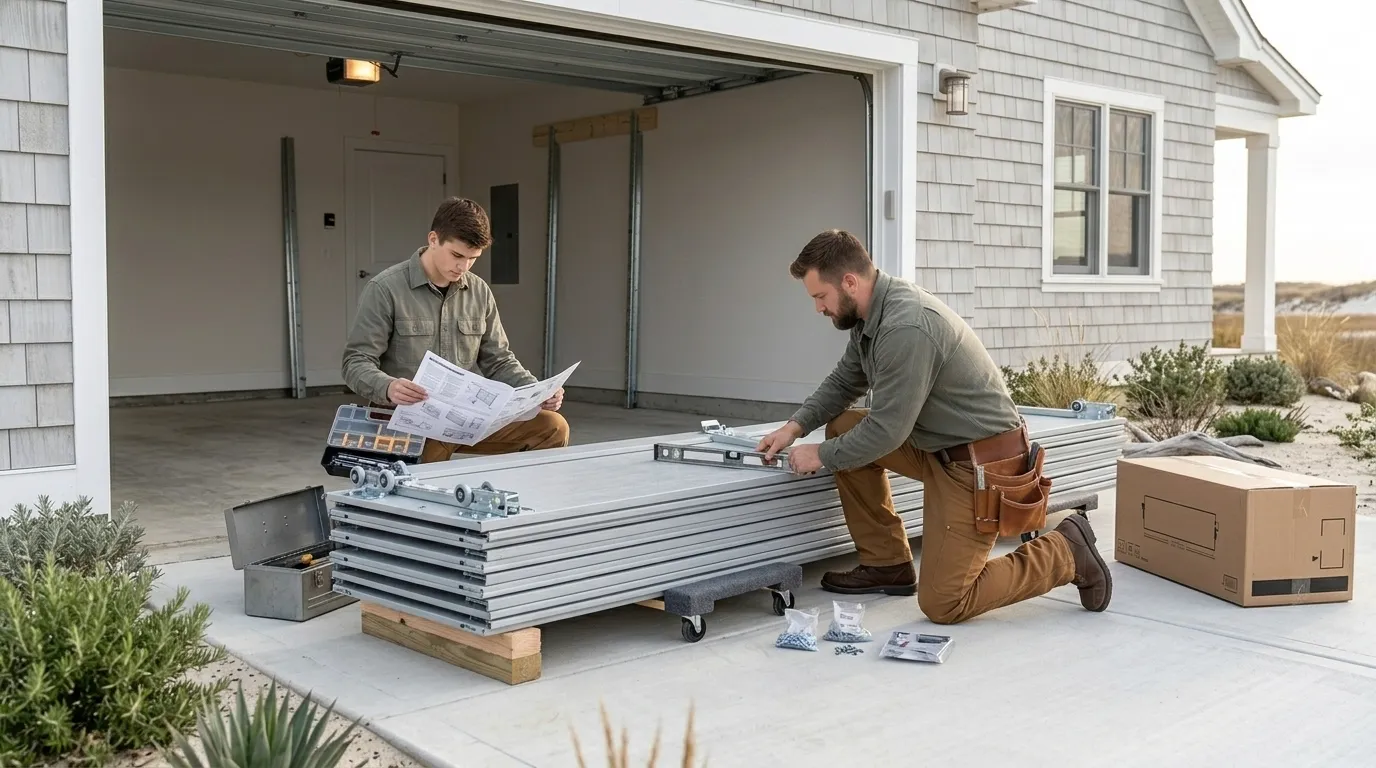
Roller replacement means pulling the old rollers out of the track, one side at a time, without dropping the door on your hand or letting a cable jump its drum. Most jobs are ten rollers per door - two at the bottom brackets, the rest riding the vertical and curved sections of track. We check the track alignment while the rollers are out, because a bent track will chew through a new set of rollers just as fast as it chewed through the old ones. If the door is original to a house built in the early 1980s, the rollers are almost always steel with open bearings, which is the cheapest option a builder could spec and the first thing to wear loose. Swapping to sealed nylon rollers is the standard upgrade, quieter and longer-lived, and it's the right call on the vast majority of the calls we run in this service area. One thing this job does not fix: if the opener has been straining against bad rollers for years, the drive gear inside the opener may already be worn, and that's a separate repair we'll tell you about honestly rather than bill you for work that won't solve the noise.
The housing stock across this service area runs from 1938 up through 2015, but the median build year lands at 1982, and most of the 24 named areas we cover were built out through the 1980s and 90s. That matters because doors from that era shipped with steel rollers on open bearings - not the sealed nylon rollers that came standard later - and those parts are now forty-plus years into a service life nobody designed them for. The climate band here is mild temperate, without the freeze-thaw cycling that cracks concrete or the deep cold that shrinks metal elsewhere. That's a mixed blessing for rollers: no ice-jam failures, but also no seasonal cue to have anyone look at the door. A roller here doesn't snap in a cold snap, it just wears quietly, grinding a little more every month, until the door is loud enough that you finally call. Across roughly 223,302 households and 99,649 owner-occupied houses in this area, a lot of garage doors are coasting on original hardware simply because nothing forced the issue.
The first sign is usually noise - a grinding or rattling that gets louder as the door travels through the curved part of the track, where a worn roller has the least contact left. Next comes a door that hesitates or catches at the same spot on every open and close, because a flat-worn or cracked roller is riding rough instead of rolling smooth. If you look at the track itself, worn rollers often leave shiny scrape marks where metal has been dragging instead of turning. Left long enough, a broken roller can jump the track entirely, and at that point the door is stuck open or shut until someone gets it back on. With a median household income of $131,314 across this service area, most owners we talk to choose to replace a full set of rollers once one starts going, rather than waiting for the rest to fail one at a time over the next year.
Swapping a roller on the bottom bracket is within reach for a handy homeowner with the door disconnected from the opener and properly secured. The rollers higher up the track are a different story - they sit close to the spring system, and on a door with a wound torsion spring, that's not a place to improvise. We'd rather tell you that up front than have you find out the hard way. If you're comfortable with hand tools and want to do the bottom two yourself, use sealed nylon rollers, not steel, and don't force a roller that's binding - a bent track needs straightening first or the new roller wears out just as fast. For anything past the bottom brackets, or if the door won't move at all, call it in.
Most residential doors run ten rollers total, two per panel section plus the bottom brackets. If one roller has failed from age rather than a one-off impact, the rest are usually close behind it, so we typically replace the full set rather than patching one at a time.
In a mild temperate climate without hard freezes, nylon rollers hold up better long-term because they don't rely on lubricated open bearings the way older steel rollers do. Steel rollers were standard on doors built through the 1980s and 90s, which is most of this area's housing stock.
Yes. A flat-worn or cracked roller drags instead of turning smoothly, and over time that scrapes and can bend the track it's riding in. Once the track itself is bent, new rollers alone won't fix the noise or the catching - the track needs straightening too.
For most doors, yes - roller replacement is a parts-and-labor job measured in an hour or two, not a full-day install. It only stops being worth it if the door's other hardware, like the springs or panels, is failing at the same time.
By Neighborhood
We also handle roller replacement in these Lake Forest-area suburbs.
Call now or request a free quote - same-day service on most repairs, upfront written pricing.