Lake Forest, CA · Garage Door Service
Temescal Valley homes mostly date to the early 2000s, newer than the 1982 median across our service area. See what that means for opener installs, from a crew based 14 miles away in Lake Forest.
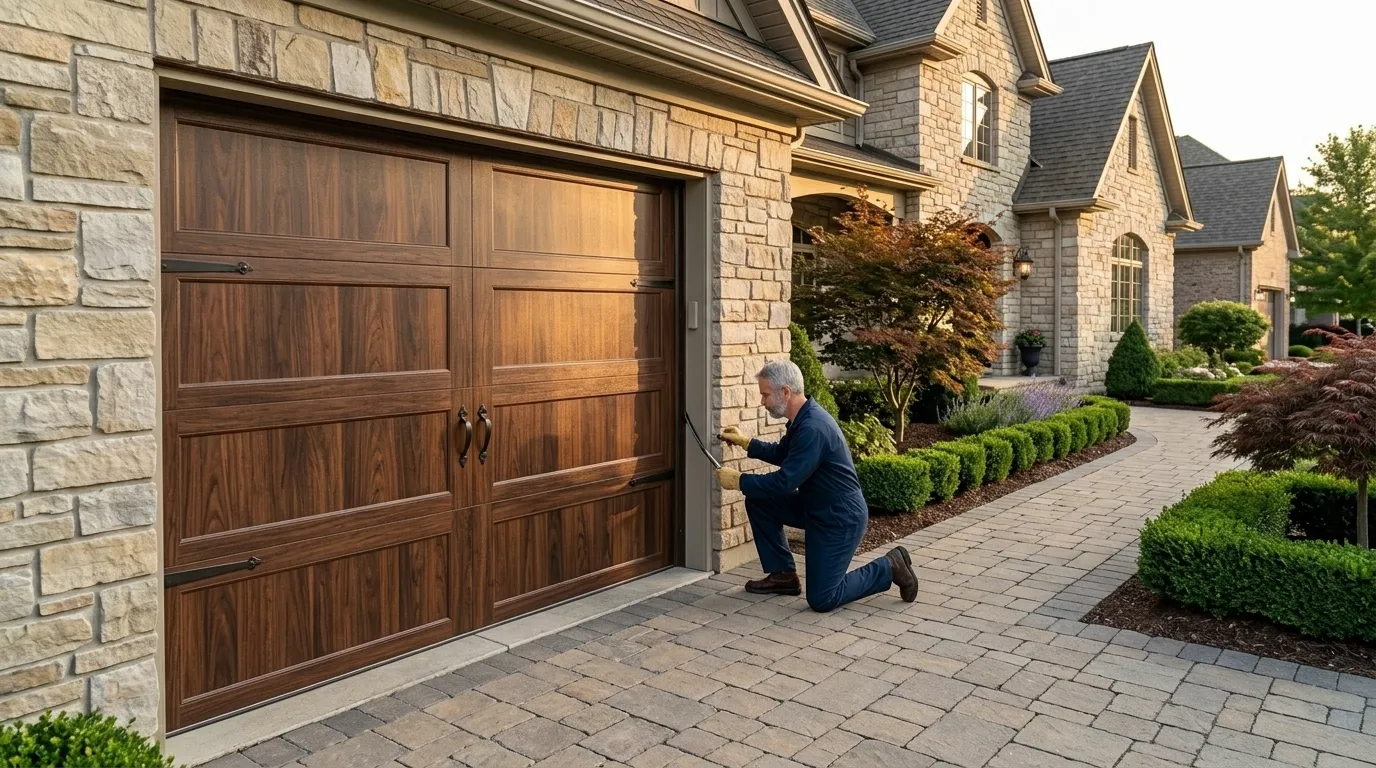
Temescal Valley is a newer build pocket compared to the rest of our service area. Where the broader territory has a median build year of 1982, homes out here mostly went up around 2003. That's a real difference when it comes to opener work. A 1980s garage usually has an older jamb, a mounting header that's shifted a little over four decades, and sometimes a bracket setup that predates the current UL 325 safety-reversal standard entirely. A 2003 house doesn't carry that baggage. The framing is square, the header is usually still true, and the electrical rough-in was likely done with an opener already in mind, since garage door openers were standard equipment by then in new construction across this part of Southern California. That means less carpentry, less bracket fabrication, and a more predictable install window. We still check travel limits, force settings, and the safety sensor alignment on every job regardless of the house's age, because a code-compliant install isn't optional, but on a 2003 structure we're rarely fighting the building itself to get there.
Newer construction doesn't mean zero problems, it means different ones. The mild temperate climate here is easy on belts, gears, and circuit boards compared to areas with real freeze-thaw cycles, so we don't see much cold-weather lubricant thickening or seal cracking. What we do see in houses this age is builder-grade openers that were installed once, in 2003 or shortly after, and never touched again. Chain drives with worn sprockets. Logic boards that predate rolling-code security and Wi-Fi entirely. Sometimes a wall control that still uses a two-wire setup nobody's updated. None of that is a Temescal Valley-specific defect, it's just what a 20-year-old opener looks like when it's finally asked to work with a smart garage app or a battery backup after a power blip. The other failure mode we run into: a homeowner adds insulation or a heavier door skin without checking whether the original opener's horsepower and travel settings still match the new door weight.
We don't have a Temescal Valley-specific price list to hand you here, and quoting a number without seeing the door, the header, and the opener you want would be a guess dressed up as a fact. What we can tell you is that the job itself tends to run faster and cheaper on a 2003-era garage than on an older one in this territory, since there's usually no header rebuild or bracket rework needed. For a firm number, we'd rather look at photos or come out and measure than throw a range at you that doesn't hold up once we're standing in your driveway.
On the truck we carry belt-drive and chain-drive openers, wall controls, safety sensor kits, and the standard mounting hardware that fits most residential headers built from the 1980s through today. For a house built around 2003, the existing bracket and header setup is usually compatible with current opener lines without modification, so most jobs use stock hardware rather than anything custom-fabricated on site. We stock parts sized for the door weights and track configurations common across this service area, not a narrow product line, because a household income and housing mix like this one (median income $119,647 locally) tends to include a wide range of door types, from lighter single-car doors to heavier insulated double doors.
We're based in Lake Forest, and Temescal Valley runs about 14 miles from there, so factor that into scheduling rather than expecting a same-hour drop-in. Once the truck is on site, a standard opener swap on a house this age typically moves faster than on older stock in our territory, since we're not stopping to rebuild a header or fabricate a bracket that's out of true. We won't promise a specific number of minutes here, because door weight, ceiling height, and whether you're keeping or replacing the wall control all shift the clock.
A basic opener swap, same mounting points, same door weight, is within reach for a homeowner comfortable on a ladder with a drill. Where we'd tell you to call instead: anything involving the torsion spring, any change in door weight or panel material that shifts the load on the opener's rail, or a header that's out of square, which is less common on a 2003 build but not impossible if the garage has settled at all. We're honest that not every job needs a truck. If it's a straightforward like-for-like swap and you're not touching the spring system, you can likely do it yourself with the manufacturer's instructions and a helper.
Generally, yes. The broader territory we cover has a median build year of 1982, but homes in Temescal Valley are mostly from around 2003. That means less bracket rework and fewer header surprises during an opener install compared to older houses in nearby areas.
No. We're based in Lake Forest, about 14 miles away, and we drive out to Temescal Valley for jobs. We don't operate a local depot or branch here, so factor drive time into your scheduling.
Probably not without an upgrade. Openers from that era commonly used two-wire wall controls and lacked rolling-code security or Wi-Fi modules, both standard on current models. A full opener swap is usually simpler than retrofitting an old unit.
Not much. This is a mild temperate climate band, so we don't see the belt or seal problems that show up in areas with hard freezes. Most opener failures we find in this area trace back to age and use, not weather.
Call now or request a free quote - same-day service on most repairs, upfront written pricing.