Lake Forest, CA · Garage Door Service
Most Temescal Valley homes were built around 2003, which means torsion springs and steel doors as standard - not the older hardware Lake Forest crews see elsewhere. Here's what a new install involves.
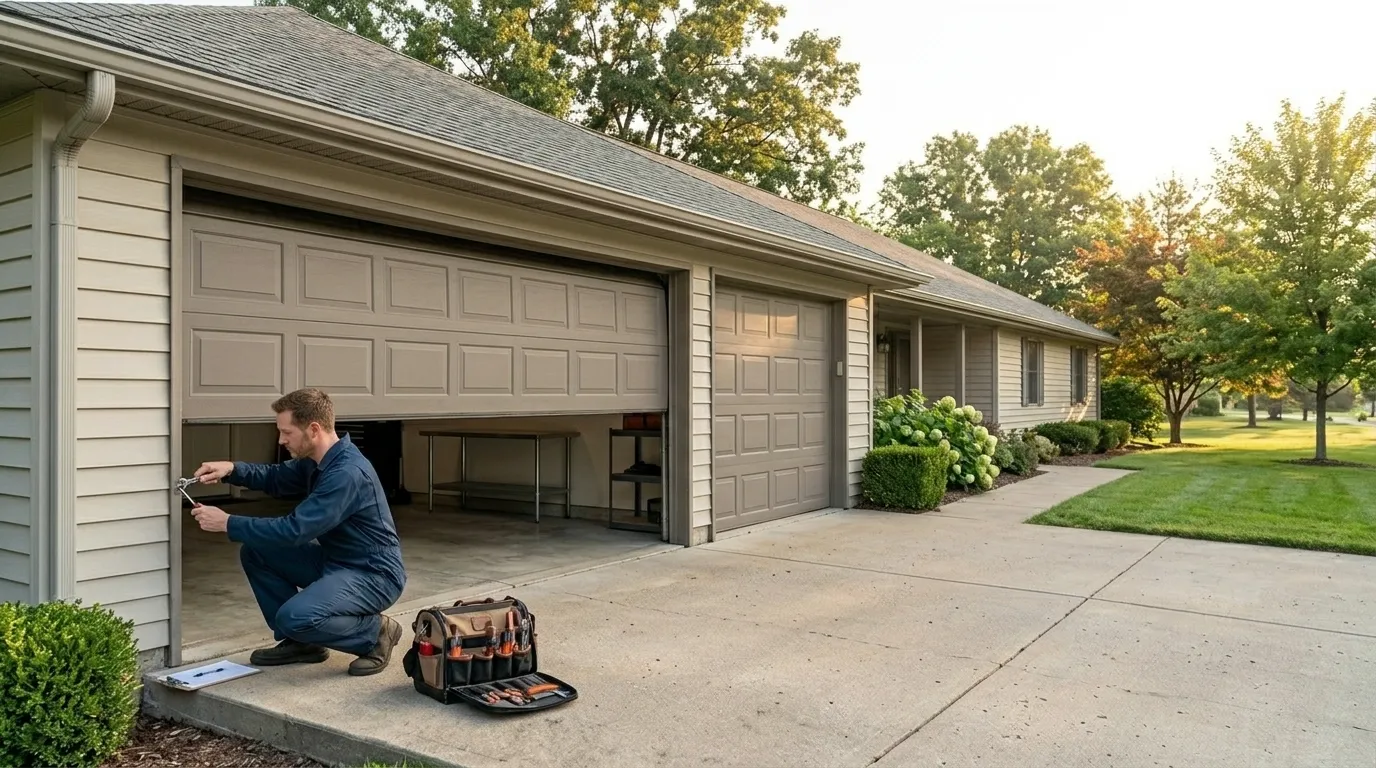
The median home in Temescal Valley went up around 2003, which puts most of the neighborhood well past the era of hand-wound extension springs and light-gauge steel doors. Builders in this window were already installing torsion spring systems as standard, along with steel raised-panel doors on galvanized track. That's good news for an install - the rough opening, header clearance, and electrical run for an opener are usually already sized correctly, so a new door install here is mostly a swap: old panels and hardware out, new door and opener in, with the existing track and jamb brackets reused if they're still square.
What changes is the door itself. A 2003-era door is over twenty years old now - the steel has usually taken enough sun and temperature swing that the finish is chalky and the insulation core (if it has one) has lost some of its R-value. Swapping the door alone, keeping the torsion spring and opener, is a smaller job than a full system replacement. We size that up on site, since we're coming from Lake Forest, about 14 miles out, and don't want to guess at a distance quote.
On a house built in this window, the failure we see most is a torsion spring that's simply worn out - most are rated for a fixed number of cycles, and a 20-plus-year-old spring on a daily-use door is often near or past that count. The second most common issue is a bent bottom panel from a car bumper or a dropped door hitting an obstruction, which on a raised-panel steel door usually means replacing that section rather than the whole door.
We also see openers from this era starting to fail - the drive gear wears out, or the circuit board that once ran a basic remote can't talk to a modern smartphone-linked system. If you're already replacing the door, that's the moment to decide whether the opener goes too, since pulling a working opener off a dying door and reinstalling it on new track is extra labor for a unit that may not last much longer anyway.
We don't have a fixed price to publish here - every job depends on door size, insulation level, and whether the spring and opener are being replaced along with the door. What we can say is that Temescal Valley households have a median income of about $119,647, somewhat lower than the wider Lake Forest service area's $131,314, and that shows up in the range of jobs we quote out here: more single-door swaps, fewer full two-car premium installs with high-end glass panels. We'll give you a firm number after we see the door, not before.
For a house built around the early 2000s, the parts that go bad first are torsion springs sized for a standard 7-foot steel door, nylon or steel rollers, and galvanized lift cable - all stock items we carry on the truck. Raised-panel steel doors in standard widths are a straightforward replacement. Where we run into lead time is with anything custom - a non-standard width, a specialty insulated core, or a glass-panel upgrade that isn't a stock size. Those get ordered and scheduled once they're in, not installed same-visit.
A straight door swap on existing track and opener - the common case in this part of Temescal Valley - usually runs a half day once we're on site. Add a spring replacement and it's not much longer, since the spring mounts to hardware that's already there. A full replacement including opener, track, and door on a two-car garage takes longer, closer to a full day, mostly because balancing a new door on new springs and calibrating a new opener's travel limits takes more careful adjustment than a like-for-like swap.
Replacing rollers or weatherstripping on a 2003-era steel door is within reach for most homeowners with basic tools - it's not risky work if the door is off its spring tension when you do it. Torsion springs are a different matter. They're wound under enough force to cause serious injury if the winding bars slip, and that risk doesn't go down because the house is newer. If your door is sagging unevenly, slamming down fast, or the spring has visibly separated, that's a call for someone with the right bars and clamps, not a Saturday project.
In most cases in Temescal Valley, yes - homes built around 2003 already have torsion hardware and standard track sized for a raised-panel steel door, so we can often reuse the track and opener if they're still in good working order. We check squareness and wear on site before recommending a full replacement versus a door-only swap.
No, we work out of Lake Forest and travel to Temescal Valley for jobs, about 14 miles each way. We quote and schedule the visit ahead of time rather than running a local depot here.
There's no fixed cutoff, but a steel door from the early 2000s is old enough that a cracked panel, a rusted-through corner, or a spring failure paired with a worn opener often costs close to what a new door runs. We'll tell you honestly which side of that line your door is on when we look at it.
Call now or request a free quote - same-day service on most repairs, upfront written pricing.