Lake Forest, CA · Garage Door Service
Garage door repair for Temescal Valley's early-2000s tract homes: 16-foot steel doors, torsion springs, and openers built after 2000. Serviced from Lake Forest.
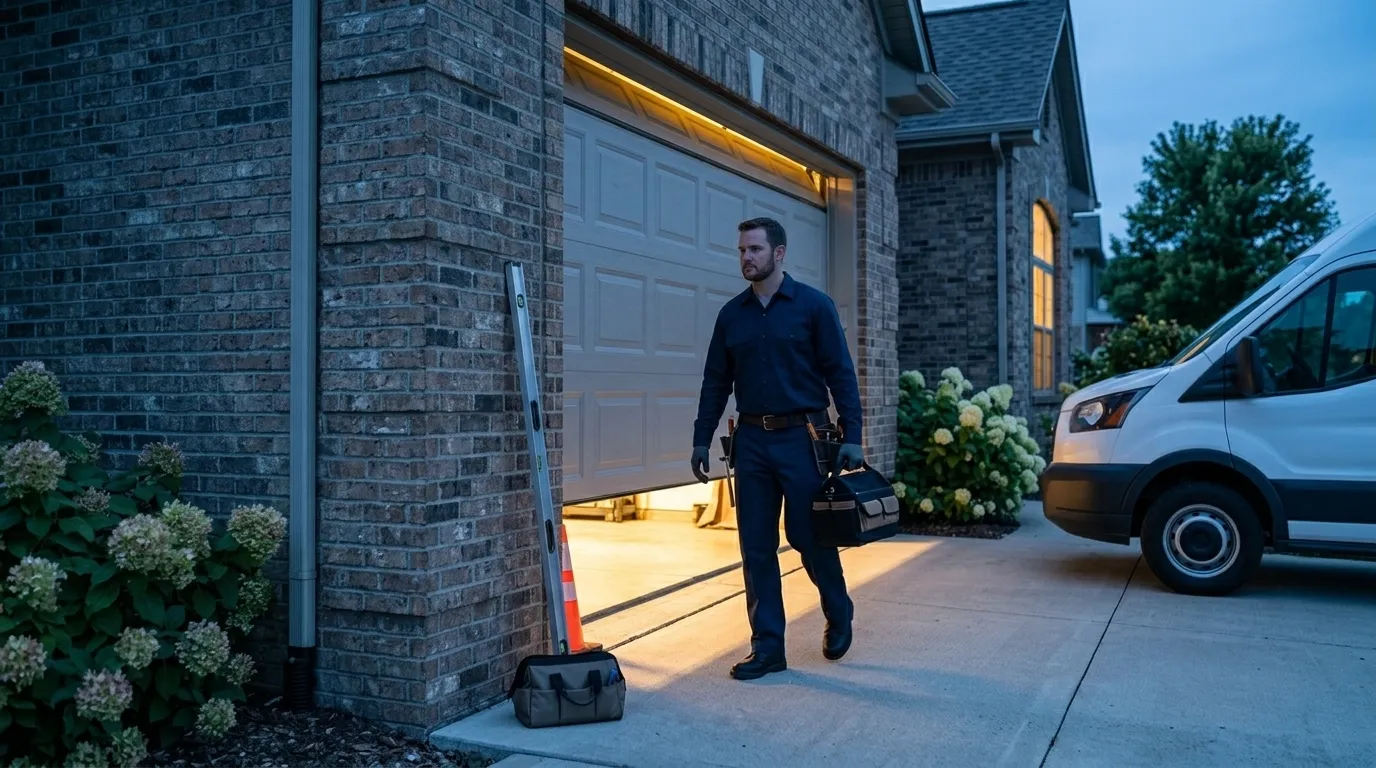
Most houses in Temescal Valley went up around 2003, which puts the doors here in a different category than the older stock we work on closer to Lake Forest. These are wide steel sectional doors, usually the 16-foot double that tract builders liked for three-car and two-car-plus-bonus layouts, hung on galvanized track with torsion springs rated for that width. The panels are steel skin over a foam core, not the older single-layer aluminum or wood you'd find on a house from the 1970s or 80s. That construction is heavier and stiffer, which changes how a fix goes. A cracked panel on a 16-foot door isn't a one-piece swap - the section has to match the exact profile and stile spacing, and repair work on a 2003-era door usually means dealing with a heavier torsion spring under more tension than what an older, narrower door would carry. Before we touch a spring or a cable on a door this size, we're thinking about that extra load, not just the fault itself. Any diagnosis starts with the door as it actually sits - width, panel type, spring count - because a fix that's routine on a narrower door can be a different job entirely at 16 feet.
On a door built around 2003, the failures we see most are torsion springs that have simply run out of cycles, nylon rollers worn oval from twenty-some years of daily use, and openers from that build era with circuit boards that finally give out. Because the double door is wide, a broken cable or a spring failure tends to show up as the door racking sideways in the track rather than just refusing to open - the extra width makes an unbalanced door more obvious and more likely to bind. We also see weatherstripping and bottom seals that have hardened and cracked; that's cosmetic more than structural, but it's a common call. What we don't see much of here is the kind of hardware failure tied to houses built before code updates required larger springs and reinforced end brackets - this stock came in after those standards, so the failures skew toward wear rather than undersized original parts.
We don't quote a price without seeing the door - spring size, opener model, and whether it's a single or double door all move the number. What we can say is that Temescal Valley's median household income runs lower than the wider Lake Forest service area's $131,314 average, and we price the same job the same way regardless of which side of the 14-mile drive it's on. A torsion spring replacement on a 16-foot double costs more in parts than the same job on a narrower single door, simply because the spring itself is bigger and the door needs two of them balanced against each other. If a job needs a special order part, we say so upfront rather than padding the estimate.
For doors from this era we carry standard torsion springs sized for wide double doors, nylon rollers, galvanized cable, and the more common bottom-bracket and end-bearing hardware that fits builder-grade steel sectional doors from the early 2000s. Openers from that period are usually a straightforward board or logic-unit swap if the motor itself is sound. What we don't stock on the truck is a matched replacement panel for every door profile out there - tract builders used a handful of different steel skin patterns, and if yours needs an exact match, that part comes in on order rather than off the shelf. We'll tell you at the door if that's the case rather than trying to force a close-enough panel into place.
We're driving out from Lake Forest, about 14 miles, so the job starts once we're on-site, not when we leave the shop. Once we're there, a spring replacement or roller swap on a door this size usually runs the same length of time as anywhere else in the service area - the width adds a bit more balancing and testing at the end, since a 16-foot door has to run true on both tracks or it'll bind again within weeks. An opener board swap is quicker. A full door replacement, if the panels are too far gone to patch, takes longer and depends on whether the exact profile is in stock or has to be ordered.
A torsion spring on a 16-foot double door carries enough stored tension to break a bone or worse if the winding bars slip - that's not a job to learn on your own driveway, regardless of what a video makes it look like. Rollers, weatherstripping, and tightening loose hardware are reasonable DIY territory if you're comfortable with a ladder and basic tools. Where we draw the line: anything involving the spring, the cable under tension, or the opener's high-voltage side. If the door is racking in the track or won't stay balanced, that's usually a spring or cable issue underneath, and it's worth a call rather than a guess.
Most homes here were built around 2003, which means wider 16-foot double doors on heavier torsion springs, built after code updates that changed spring sizing and bracket reinforcement. Older neighborhoods closer to Lake Forest often have narrower doors and different original hardware, so the same fault calls for a different part.
No. We're based in Lake Forest and drive out to Temescal Valley, about 14 miles, for every job. There's no local depot, so scheduling is set around the drive, not a standing crew in the area.
It costs more than on a narrower single door because the spring itself is larger and two springs need to balance against each other. We won't give a firm number without seeing the door and opener, but we'll tell you upfront if a part needs to be special-ordered.
Yes, that's reasonable DIY work if you're comfortable on a ladder. Just don't touch the torsion spring or the cable under tension while you're in there - those carry enough stored force to cause serious injury and aren't a same-day learning project.
Call now or request a free quote - same-day service on most repairs, upfront written pricing.