Lake Forest, CA · Garage Door Service
North Tustin homes run older than most of the area, and at a $186,250 median income, replacement often pencils out faster than repeated fixes. Here's why.
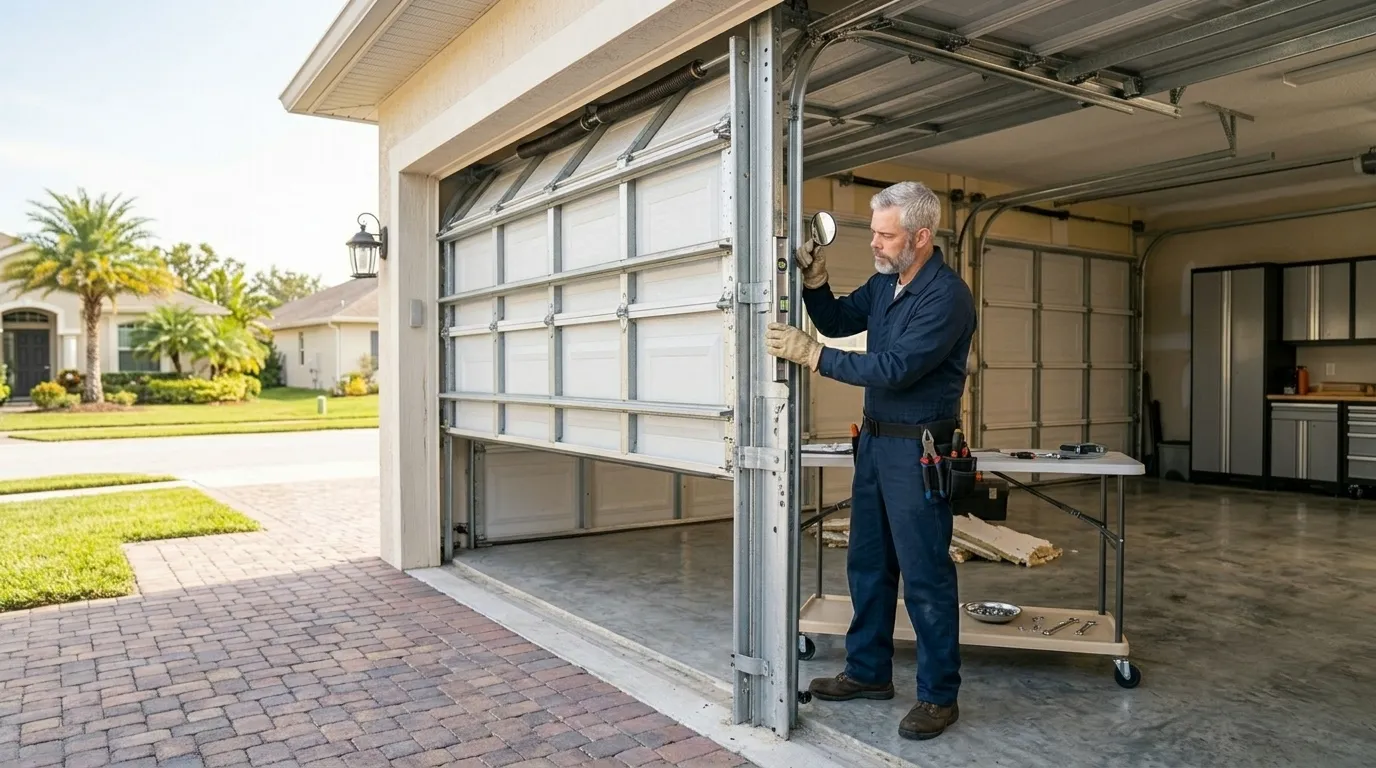
North Tustin's median household income sits at $186,250, well above the $131,314 median across the rest of the area we cover, and that number matters before you even open the garage. At that income level, a homeowner calling about a noisy opener or a sagging panel usually isn't choosing between a $200 patch and doing nothing - they're deciding whether to fix a fifteen-year-old system or replace it outright, and the math tips toward replacement sooner than it does elsewhere.
That decision comes up a lot here because the housing stock skews older. North Tustin's median build year is 1965, a good fifteen years ahead of the wider service area's 1982 median. Doors from that era were built for lighter, often single-layer steel or wood panels, paired with extension springs mounted along the horizontal track rather than the torsion bars common in newer construction. Extension spring assemblies wear differently - cables fray at the pulley, safety cables go missing entirely on the oldest installs, and the openers bolted to them are frequently past any parts support.
What we see on these calls: frayed lift cables, pulley wear, and openers with chain drives loud enough to rattle a house built in the 1960s. Panels themselves often outlast the hardware bolted to them.
On a 1965-era door, the first job is often deciding what to keep. If the panels are steel and square, a torsion conversion - pulling the old extension springs and track hardware and installing a torsion bar with matched springs - is usually worth doing, since it cuts the cable and pulley failure points down to almost nothing. If the panels are warped, dented, or wood that's delaminating, we say so and price a new door instead of patching around a frame that isn't worth saving.
Spring sizing on these older doors is not a guess. A torsion spring has to match the door's weight and the drum size on the shaft, and getting it wrong either burns out an opener early or leaves the door too heavy to lift by hand if the power goes out. We measure rather than swap in whatever's on the truck.
Opener replacement is common on these calls too. A chain-drive unit from decades back has usually outlived its circuit board and its warranty both. Where the household budget supports it - and at North Tustin's income level it often does - we'll walk through belt-drive options rather than defaulting to the cheapest chain unit, since noise complaints are the number one callback we get on older homes.
A straightforward spring or cable repair on one of these older doors runs the same couple of hours as anywhere else - nothing about 1965 hardware makes the repair itself slower once we're on site. What can add time is sourcing. Some of the oldest door sections and track hardware in North Tustin are sized differently than anything sold new, and if a single panel needs matching rather than replacing the whole door, that part isn't sitting on the truck. We'll tell you upfront if a job needs a special order instead of promising a same-visit fix we can't back up.
A full torsion conversion or opener swap is a longer visit, usually most of a morning or afternoon, since it involves removing old hardware entirely rather than working around it.
One honest limitation: we don't stock every obsolete panel size, and on a door old enough to have hand-cut wood panels, matching one section exactly sometimes isn't possible. In those cases replacing the full door is the realistic answer, not a promise to hunt down a match that may not exist.
The math that opened this page is the math that closes it. With roughly 8,926 households in North Tustin and a median income well clear of the area average, the calculation homeowners here run isn't "can I afford the repair" - it's "does another repair make sense on a door this age." On a house with a 1965 median build year, a garage door and opener are often on their second or third owner without ever being swapped, and every added repair on aging track and cable hardware is a bet against the next failure being bigger.
We drive the 10 miles from Lake Forest to reach North Tustin, which is close enough that a diagnostic visit isn't a special trip, but it also means we're not a local depot - no drop-in without a call first. Given the age of the housing stock here, we'd rather spend fifteen minutes on-site telling a homeowner that replacement beats a fourth repair than sell a torsion spring onto hardware that's going to strand the next part anyway.
Not automatically. If the frame and track are square and the panels aren't warped, a torsion conversion or opener swap can extend a 1960s door for years. It becomes a replacement conversation when the panel material itself has failed - rust-through steel or delaminating wood - since there's nothing left to bolt new hardware to.
Chain-drive openers from decades back often run on circuit boards that are no longer supported, so a failed logic board means the whole unit, not a part. If your opener predates modern safety sensors, we'll flag that too, since it's a safety gap worth closing regardless of what else is wrong.
For common torsion springs and cables, yes. For older panel sizes or hand-fitted sections specific to a 1960s install, not always - some of those simply aren't manufactured anymore, and we'll tell you that on the call rather than promise a same-day match.
About 10 miles. We work North Tustin as part of our regular service area, but we're based in Lake Forest, so a visit is scheduled rather than a walk-up call.
Call now or request a free quote - same-day service on most repairs, upfront written pricing.